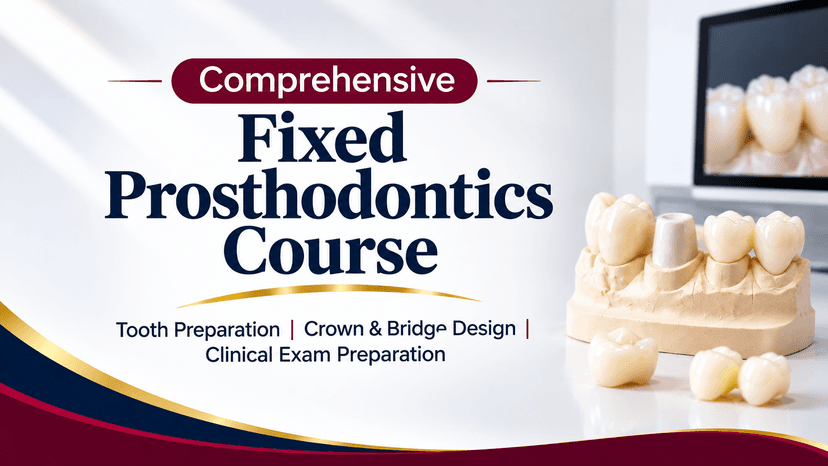
Fixed Prosthodontics Course | Hands-On Crown & Bridge and Tooth Preparation Training
Develop confident crown and bridge skills with MCDI's hands-on Fixed Prosthodontics Course — covering tooth preparation for all ceramic and metal-ceramic restorations, gingival retraction, impression techniques, temporisation, shade selection, and cementation protocols with real patient clinical sessions and expert faculty supervision.
Overview
Highlights of the Institute
- Expert-Led Dental Education by Experienced Faculty
- Hands-on Clinical Dental Training
- Live Patient Treatment Experience
- One-to-One Faculty Mentorship
- Expert MDS Faculty & Clinical Trainers
- Evidence-Based Clinical Dentistry
- Chairside Clinical Demonstrations
- Advanced Dental Equipment & Armamentarium
- Modern Clinical Protocols & Techniques
- Step-by-Step Clinical Learning
- Comprehensive Clinical Case Discussions
- Individual Clinical Guidance
- Practical Skill Development
- Real-Time Treatment Planning
- Infection Control & Sterilization Training
- Digital Dentistry Exposure
- Endodontics, Implantology & Prosthodontics Training
- CBCT & Dental Radiology Learning
- Access to Latest Dental Materials & Technologies
- Hands-on Use of Rotary Endodontics Systems
- Clinical Documentation & Case Record Maintenance
- Interactive Doubt-Clearing Sessions
- Professional Practice Management Tips
- Certificate of Completion
- Flexible Weekday & Weekend Batches
- Career-Oriented Dental Training
- Suitable for BDS, MDS & General Dentists
- Clinical Confidence Building
- Personalized Learning Environment
- Continuous Faculty Support Throughout the Course
Syllabus & Curriculum
10 modules · 121 lessons
- •Principles of fixed prosthodontics
- •Patient examination and diagnosis
- •Crown and bridge case selection
- •Treatment planning
- •Abutment evaluation
- •Comprehensive medical and dental history assessment for prosthodontic patients
- •Radiographic analysis — periapicals, OPG and CBCT for crown and bridge planning
- •Periodontal evaluation and soft tissue assessment before fixed prosthetics
- •Pulpal status assessment and endodontic considerations before crown preparation
- •Occlusal analysis and study model evaluation for treatment planning
- •Digital smile design and pre-treatment esthetic analysis
- •Risk assessment and prognosis determination for abutment teeth
- •Informed consent and patient communication in fixed prosthodontics
- •Principles of tooth preparation
- •Tooth reduction
- •Retention and resistance form
- •Finish line designs
- •Common preparation errors
- •Hands-on crown preparation
- •Taper and convergence angle — ideal parameters in crown preparation
- •Depth orientation grooves and reduction guides for uniform tooth reduction
- •Crown lengthening — indications and timing before tooth preparation
- •Preparation of teeth with existing large restorations and compromised structure
- •Ferrule effect — its importance and how to achieve it clinically
- •Margin placement decisions — supragingival vs subgingival based on clinical factors
- •Anterior crown preparation
- •Posterior crown preparation
- •Full metal crown preparation
- •PFM crown preparation
- •All-ceramic crown preparation
- •Clinical evaluation of preparations
- •Zirconia crown preparation — specific thickness and taper requirements
- •Lithium disilicate (e.max) crown preparation — thin margins and reduction guide
- •Shoulder margin vs chamfer margin — when to use each and why
- •Preparation for endodontically treated teeth — post, core and crown considerations
- •Ideal occlusal reduction for posterior crowns — cusp and fossa guidelines
- •Incisal and labial reduction for anterior crowns — esthetic considerations
- •Fixed partial denture principles
- •Abutment preparation
- •Path of insertion
- •Pontic design
- •Connector design
- •Hands-on bridge preparation
- •Span length and occlusal load — limitations in multi-unit bridge design
- •Maryland bridge and adhesive bridge preparations — indications and technique
- •Cantilever bridge — clinical indications, contraindications and biomechanics
- •Paralleling multiple abutments — path of insertion and common errors
- •Abutment tooth health evaluation — periodontium, bone support and root morphology
- •Implant-supported bridge considerations and differences from tooth-supported bridges
- •Impression materials
- •Gingival retraction
- •Soft-tissue management
- •Final impressions for crowns and bridges
- •Impression evaluation
- •Clinical troubleshooting
- •Two-step vs one-step impression technique — advantages and indications
- •Double-mix impression technique for accurate crown and bridge impressions
- •Digital impressions and intraoral scanners — workflow in fixed prosthodontics
- •Impression evaluation criteria — identifying voids, tears and inaccuracies
- •Disinfection, labelling and handling of impressions before lab dispatch
- •Bite registration techniques — silicone, wax and zinc oxide eugenol options
- •Principles of temporization
- •Provisional crown fabrication
- •Provisional bridge fabrication
- •Marginal adaptation
- •Occlusal adjustment
- •Esthetic evaluation
- •Direct vs indirect technique for provisional crown fabrication
- •Provisional materials — PMMA vs bis-acryl composites — comparison and selection
- •Aesthetics and function of provisionals — managing patient expectations
- •Long-term provisionals in complex full-mouth rehabilitation cases
- •Provisional cement selection, placement and removal without damage
- •Occlusal principles
- •Intercuspal position
- •Articulator concepts
- •Functional occlusion
- •Occlusal adjustment
- •Clinical occlusal evaluation
- •Facebow transfer and mounting of study models on a semi-adjustable articulator
- •Centric relation vs centric occlusion — clinical relevance in fixed prosthodontics
- •Canine-guided occlusion vs group function — when to prescribe each
- •Protrusive and lateral excursive movements — relevance in crown design
- •Curve of Spee and Curve of Wilson — their clinical significance in bridge design
- •Crown try-in
- •Bridge try-in
- •Marginal adaptation
- •Contact evaluation
- •Occlusal verification
- •Esthetic assessment
- •Seating resistance during try-in — causes, detection and correction
- •Proximal contact evaluation — shimstock and dental floss techniques
- •Shade verification under multiple light sources — natural, operatory and external
- •Patient approval process and documentation before final cementation
- •Glazing, polishing and surface finishing of crowns and bridges before delivery
- •Cement selection
- •Crown cementation
- •Bridge cementation
- •Cementation protocols
- •Final occlusal adjustment
- •Post-cementation instructions
- •Tooth surface preparation — cleaning, drying and conditioning before cementation
- •Temporary cementation vs definitive cementation — clinical decision-making
- •Zinc phosphate, GIC, RMGIC and resin cement — properties and clinical selection
- •Adhesive cementation protocol for all-ceramic and e.max restorations
- •Cement cleanup — flash removal and interproximal excess management
- •Post-cementation patient instructions and recall protocol for fixed prosthetics
- •Complete crown and bridge case planning
- •Anterior tooth preparation - 3 teeth
- •Posterior tooth preparation - 3 teeth
- •Clinical problem-solving
- •Management of common complications
- •Case-based treatment planning - 5 cases
- •Hands-on fixed prosthodontic training
- •Impression techniques- 5 cases
- •Retraction cord placement - 5 teeth
- •Shade taking
- •Provisional crown making - 6 teeth
- •Full-mouth rehabilitation with crowns and bridges — integrated case planning
- •Managing patient anxiety and expectations during multi-visit prosthodontic treatment
- •Clinical photography and documentation for fixed prosthodontic cases
- •Post-treatment review, maintenance and long-term recall for crowns and bridges
Schedule
- Duration: 3 days
- Mode: Offline
- Language: English
- Subtitles: None
- Access: 1 month access
Certification
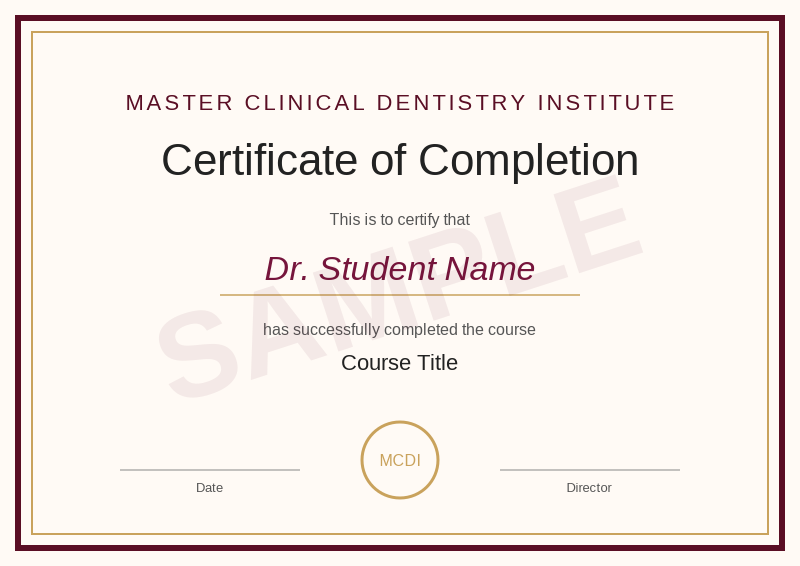
Certificate of completion issued by Master Clinical Dentistry Institute
Certified by Orikam, Neoendo, Eighteeth, Itena
Course Rules
- Submit all required documents before the commencement of the course.
- Course will begin only after document verification and full fee payment.
- Maintain punctuality for all lectures, demonstrations, and clinical sessions.
- Students are responsible for the safety and maintenance of their own instruments.
- Any damage to institute equipment, instruments, materials, furniture, or property must be borne by the student.
- Students must follow all faculty instructions during practical and clinical sessions.
- No clinical procedure should be performed without faculty supervision.
- Any injury, complication, or damage caused to a patient due to student negligence shall be the sole responsibility of the student.
- All medical expenses, compensation, or legal liabilities arising from student negligence shall be borne by the student.
- Wear a clean apron/lab coat and appropriate PPE during clinical sessions.
- Maintain professional behaviour with patients, faculty, staff, and fellow participants.
- Photography, videography, or recording of lectures, patients, or clinical procedures is prohibited without prior permission.
- Mobile phones should remain on silent mode during classes and clinical sessions.
- Maintain cleanliness and infection control protocols at all times.
- Smoking, alcohol consumption, or use of tobacco products is strictly prohibited within the institute premises.
- Certificates will be issued only after successful completion of the course and fulfillment of attendance requirements.
- Course fees are non-refundable and non-transferable.
- Master Clinical Dentistry Institute reserves the right to modify course schedules, faculty, or training modules whenever required.
- The course will commence within two weeks of successful fee payment and document verification.
- Bring your own Air Rotor Handpiece for the course.
- Maintain complete patient records and clinical files after every patient treated during the course.
- The institute reserves the right to photograph or video record students, patients, lectures, demonstrations, and clinical training sessions for academic documentation, quality assurance, promotional, and record-keeping purposes.
- Students must maintain professional behaviour, discipline, and politeness with patients, faculty, staff, and fellow participants at all times.
- If you have any doubts, concerns, or grievances during the course, you may contact the Head of the Institute for assistance.
- Maintain strict infection control and sterilization protocols throughout the training.
- Master Clinical Dentistry Institute reserves the right to modify the course schedule, faculty, clinical postings, or training modules whenever necessary.
Who Should Join This Course?
- BDS Graduates & Dental Interns Seeking Fixed Prosthodontics Training
- General Dental Practitioners Upgrading Crown & Bridge Skills
- Dentists Wanting to Learn Tooth Preparation, Impressions & Cementation
- Dentists Seeking Hands-On Crown, Bridge & Veneer Training
- Dental Practitioners Looking to Improve Fixed Prosthetic Workflows
- Dentists Interested in Occlusal Rehabilitation & Bite Correction
- MDS Prosthodontics Aspirants Strengthening Clinical Competency
- Dentists Interested in Digital Prosthodontics & CAD/CAM Workflows
- Dentists Looking to Manage Multi-Unit Restorative Cases
- Implantologists Seeking Prosthetic Workflow Training
Prerequisites
- BDS degree or equivalent dental qualification from a recognised dental college
- Valid registration with the Dental Council of India or State Dental Council
- Interest in hands-on clinical training; prior clinical exposure is an advantage
Highlights of the Course
Meet Your Faculty

Dr. Sneha Gaonkar
Prosthodontics and Crown & Bridge
3 years senior resident, 1 yr Bond Lecturer, 6 months junior resident, 2 yrs clinical practice in private
I will teach the fundamentals and advanced concepts of fixed prosthodontics, including tooth preparation principles, crown and bridge procedures, margin designs, impression techniques, provisional restorations, luting cements, pontic designs, and occlusion.

Garima Makhija
Prosthodontics and Crown & Bridge
2 years
I would conduct hands-on Crown and Bridge training using a structured, step-by-step approach, beginning with theoretical principles and progressing to supervised preclinical practice. I would teach tooth for full metal crowns, porcelain-fused-to-metal crowns and all ceramic crowns.
Questions & Answers
Enrolled students ask; the course faculty answer. Answered questions are shown here for everyone.
No answered questions yet.
Enrollment & Course Activation Policy
Classroom Course
- Classroom Courses will commence within 2 weeks of successful registration.
- Course commencement is subject to faculty availability, and mutual confirmation between the student and the faculty.
Important Note
1. Registration & Fee Payment Complete the course registration with the institute. The applicable course fee must be paid at the time of registration to confirm your enrollment. Your course will be scheduled to begin approximately two weeks after registration and fee payment. 2. Additional Patient Cases The course includes the number of clinical cases specified in your selected package. If you wish to increase the number of patient cases, inform the institute in advance. Additional cases will be subject to availability and additional charges. 3. Personal Clinical Equipment Participants must bring their own air rotor/handpiece for the course. Participants should also carry the required PPE kit for the course. 4. Initial Practice on Extracted Teeth Clinical training will begin with practice on extracted teeth. The participant will first become familiar and comfortable with the required clinical techniques and procedures. The supervising faculty will assess the participant's technique and readiness. 5. Progression to Patient Work Patient-based clinical work will begin only after the participant demonstrates adequate comfort and competence during the initial practice. All patient procedures will be performed under faculty supervision and guidance. Patient safety, proper clinical technique, and professional standards will be maintained throughout the training. 6. Clinical Training Sequence Registration → Fee Payment → Course Starts After 2 Weeks → Practice on Extracted Teeth → Faculty Assessment → Supervised Patient Work → Additional Cases if Requested
What's included
- Course Duration : 3 days
- One-on-one mentoring sessions
- Certificate of completion
- Certified by Orikam, Neoendo, Eighteeth, Itena
- 1 month access to course materials
Common questions
What does the fixed prosthodontics course cover?
The fixed prosthodontics course covers full-crown preparation, bridge design, impression techniques, temporary restorations, cementation, shade matching and CAD/CAM basics on real patients. Every session involves direct, supervised work on real patients at MCDI's fully equipped clinical facility.
Who should attend a fixed prosthodontics hands-on training course?
This course is designed for general dentists seeking to improve crown and bridge quality and confidence through supervised real patient practice. It is ideal for dentists who learn best through hands-on practice rather than online study alone.
Where is the fixed prosthodontics course conducted?
All sessions are held at MCDI's fully equipped dental clinical training facility.
Questions about this course? Get a call back
Leave your number and we'll call you back, or chat with us on WhatsApp.
Fixed Prosthodontics Course | Hands-On Crown & Bridge and Tooth Preparation Training
₹41,999 (incl. GST) · instant access after payment · 1 month access
Refund policyRelated Courses
Rubber Dam Course for Dentists | Hands-On Rubber Dam Isolation Training
Hands-on Rubber Dam Course for Dentists. Master isolation, clamp selection & endodontic techniques at MCDI. Offline.
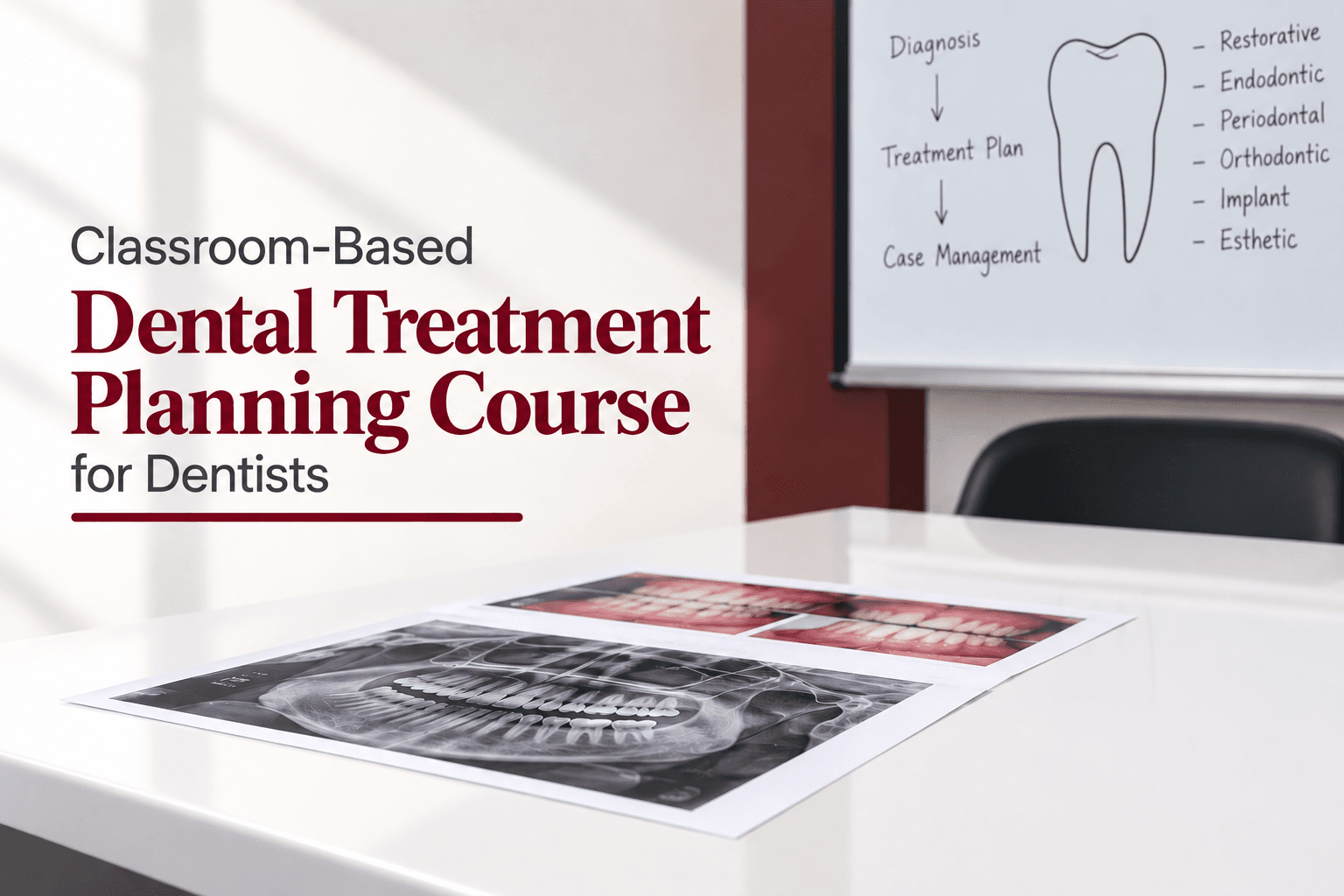
Classroom-Based Dental Treatment Planning Course for Dentists
Build systematic, confident treatment planning skills through case-based workshops, phased design, and real patient assessment sessions.
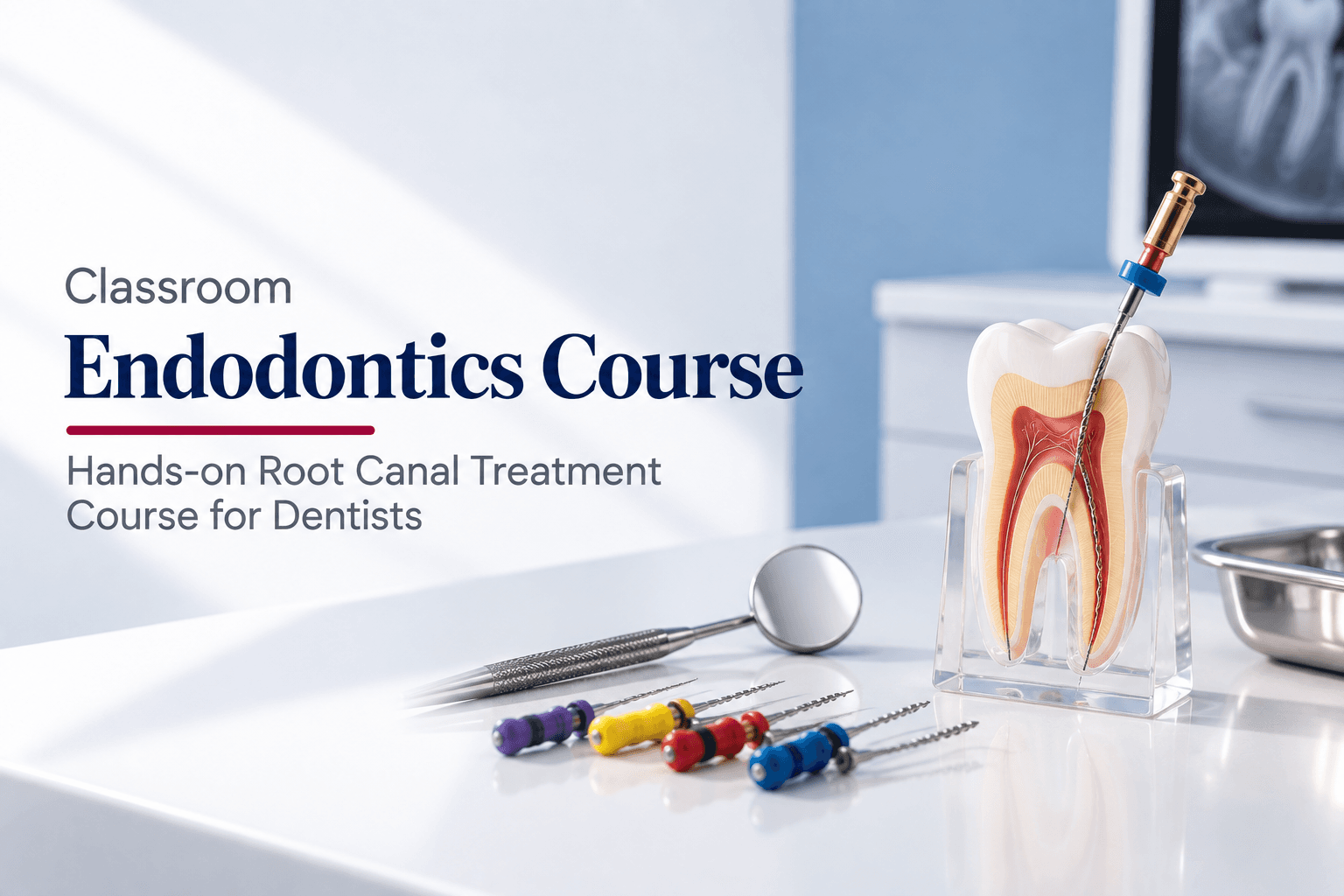
Endodontic Course for Dentists | Hands-On Root Canal & Rotary Endodontic Training
Master modern root canal techniques with MCDI's hands-on Endodontic Course for Dentists — covering rubber dam isolation, rotary instrumentation, apex locators, single-visit RCT, and complex case management with real patient practice and expert endodontic faculty supervision at a fully equipped clinic.