Endodontic Course for Dentists | Hands-On Root Canal & Rotary Endodontic Training
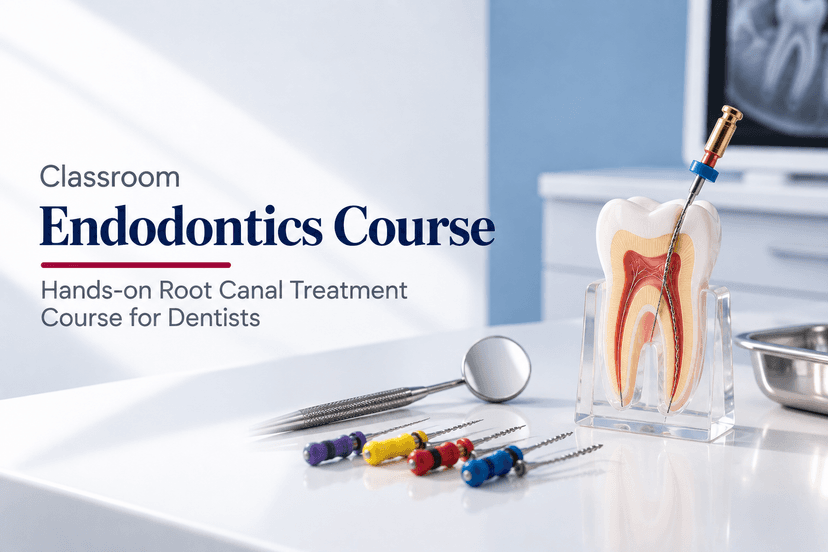
Master modern root canal techniques with MCDI's hands-on Endodontic Course for Dentists — covering rubber dam isolation, rotary instrumentation, apex locators, single-visit RCT, and complex case management with real patient practice and expert endodontic faculty supervision at a fully equipped clinic.
Overview
Highlights of the Institute
- Expert-Led Dental Education by Experienced Faculty
- Hands-on Clinical Dental Training
- Live Patient Treatment Experience
- One-to-One Faculty Mentorship
- Expert MDS Faculty & Clinical Trainers
- Evidence-Based Clinical Dentistry
- Chairside Clinical Demonstrations
- Advanced Dental Equipment & Armamentarium
- Modern Clinical Protocols & Techniques
- Step-by-Step Clinical Learning
- Comprehensive Clinical Case Discussions
- Individual Clinical Guidance
- Practical Skill Development
- Real-Time Treatment Planning
- Infection Control & Sterilization Training
- Digital Dentistry Exposure
- Endodontics, Implantology & Prosthodontics Training
- CBCT & Dental Radiology Learning
- Access to Latest Dental Materials & Technologies
- Hands-on Use of Rotary Endodontics Systems
- Clinical Documentation & Case Record Maintenance
- Interactive Doubt-Clearing Sessions
- Professional Practice Management Tips
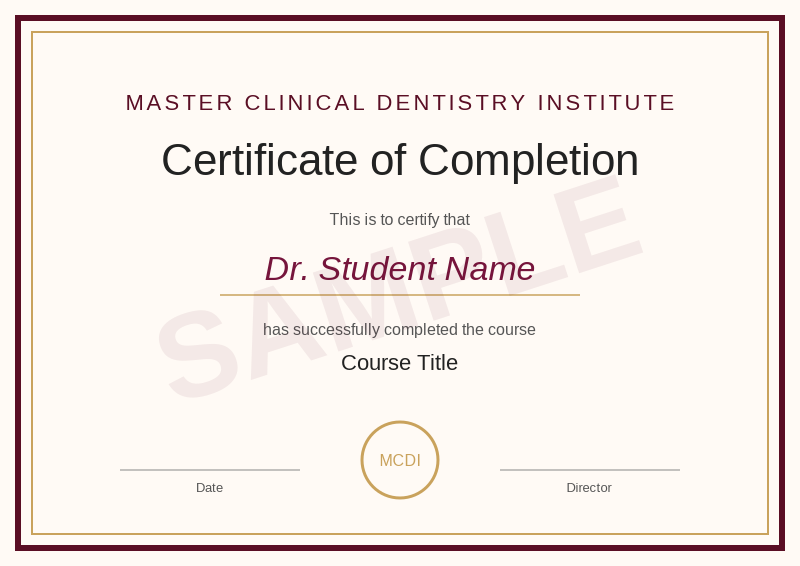
- Certificate of Completion
- Flexible Weekday & Weekend Batches
- Career-Oriented Dental Training
- Suitable for BDS, MDS & General Dentists
- Clinical Confidence Building
- Personalized Learning Environment
- Continuous Faculty Support Throughout the Course
Syllabus & Curriculum
19 modules · 154 lessons
- •Introduction to Basic Endodontics
- • Pulp & Periapical Anatomy
- •Root Canal Anatomy
- •Pulpal & Periapical Diagnosis
- •Endodontic Case Selection
- •Treatment Planning for Root Canal Treatment
- •Indications & Contraindications of RCT
- •Pre-operative Assessment & Radiographs
- •Importance of Isolation
- •Rubber Dam Armamentarium
- •Clamp Selection & Placement
- •Rubber Dam Placement
- •Rubber Dam Isolation for Anterior Teeth
- •Rubber Dam Isolation for Posterior Teeth
- •Isolation Techniques
- •Isolation of Difficult Cases
- •Leakage Prevention & Moisture Control
- •Common Errors & Solutions
- •Rubber Dam Isolation in Every Patient Case
- •Principles of Endodontic Access
- •Access cavity preparation principles
- •Root canal anatomy and canal location techniques
- •Identification of pulp chamber and canal orifices
- •Anterior & Posterior Access Cavity Preparation
- •Variations in anterior, premolar, and molar canals
- •Conservative Access Preparation
- •Avoiding Procedural Errors
- •Canal Exploration & Negotiation
- •Glide Path Preparation
- •Working Length Determination
- •Electronic Apex Locator
- •Radiographic Working Length Verification
- •Hand Instrumentation
- •Prevention of Instrument Separation
- •Management of Common Canal Anatomy
- •Hand and rotary instrumentation
- •Irrigation protocols and disinfection
- •Glide path creation, crown-down and step-back techniques
- •Irrigation protocols: sodium hypochlorite, EDTA, chlorhexidine
- •Working length determination: radiographic and electronic apex locators
- •Principles of Root Canal Preparation
- •Manual Instrumentation Techniques
- •Rotary & Reciprocating Endodontics
- •Basic NiTi Instrumentation
- •Canal Irrigation Protocols
- •Irrigant Selection & Activation
- •Smear Layer Management
- •Prevention of Procedural Errors
- •Gutta-Percha
- •Root Canal Sealers
- •Single Cone Technique
- •Cold Lateral Compaction
- •Warm Vertical Compaction
- •Bioceramic Obturation
- •Obturation materials and techniques
- •Common complications and case-based learning
- •Cold lateral condensation and warm vertical compaction
- •Choosing the right sealer for clinical cases
- •Radiographic assessment of obturation quality
- •K Files
- •H Files
- •Glide Path Preparation
- •Step-Back Technique
- •NiTi Rotary Systems
- •Crown-Down Technique
- •Glide Path
- •File Selection
- •Torque & Speed Settings
- •Prevention of Instrument Separation
- •Sodium Hypochlorite
- •EDTA
- •Chlorhexidine
- •Ultrasonic Activation
- •Smear Layer Removal
- •Separated Instruments
- •Ledge Formation
- •Canal Transportation
- •Root Perforation
- •Sodium Hypochlorite Accident
- •Vertical Root Fracture
- •Temporary Restoration
- •Fiber Post
- •Post and Core
- •Endocrown
- •Full-Coverage Crowns
- •Coronal Seal
- •Case Presentation
- •Treatment Planning
- •Complication Management
- •Documentation & Consent
- •Infection Control
- •Patient Communication
- •Clinical Tips & Troubleshooting
- •Patient-Based Clinical Training: 2 Anterior Cases
- •Live Patient Root Canal Training - Independent Work Upon Patient under the guidance of Super Specialised Faculty Members.
- •Case Assessment & Diagnosis
- •Pre-operative Radiograph
- •Rubber Dam Isolation
- •Access Cavity Preparation
- •Working Length Determination
- •Cleaning & Shaping
- •Irrigation Protocol
- •Intracanal Medicament
- •Inter-appointment Temporary Restoration
- •Obturation
- •Post-operative Radiograph
- •Coronal Seal & Restoration
- •Live Patient Root Canal Training - Independent Work Upon Patient under the guidance of Super Specialised Faculty Members.
- •Patient-Based Clinical Training: 2 Posterior Cases
- •Posterior Endodontic Case Selection
- • Pre-operative Assessment
- •Rubber Dam Isolation
- •Posterior Access Cavity
- •Canal Orifice Identification
- •Working Length Determination
- •Cleaning & Shaping of Multiple Canals
- •Irrigation & Canal Disinfection
- •Intracanal Medicament
- •Temporary Sealing Between Visits
- •Obturation of Posterior Canals
- •Post-operative Radiographic Evaluation
- •Coronal Restoration
- •Patient-Based Clinical Training: 1 Single-Visit RCT Case
- •Live Patient Root Canal Training - Independent Work Upon Patient under the guidance of Super Specialised Faculty Members.
- •Case Selection for Single-Visit Endodontics
- •Diagnosis & Treatment Planning
- •Rubber Dam Isolation
- •Access Cavity Preparation
- •Working Length Determination
- •Cleaning & Shaping
- •Irrigation & Disinfection
- •Obturation in Single-Visit RCT
- •Immediate Coronal Seal/Restoration
- •Post-operative Radiographic Assessment
- •Patient-Based Clinical Training: 1 Vital Pulp Therapy Case
- •Pulpal Diagnosis & Case Selection
- •Indications for Vital Pulp Therapy
- •Pulp Preservation Principles
- •Rubber Dam Isolation
- •Caries Removal & Pulp Exposure Management
- •Pulpotomy Principles
- •Hemostasis & Disinfection
- •Biocompatible Pulp-Capping Materials
- •Biodentine/MTA-Based Materials
- •Definitive Coronal Restoration
- •Follow-Up & Clinical Evaluation
- •Regenerative endodontics (revascularization)
- •CBCT (Cone Beam CT) in Endodontics
- •Laser-Assisted Endodontics
- •Bioceramic Sealers & Materials
- •Reciprocating & Adaptive Motion File Systems
- •Photodynamic Therapy in Endodontics
- •Endodontic Microsurgery – Latest Techniques
- •Electronic Apex Locators – Latest Advancements
Schedule
- Duration: 3 days
- Mode: Offline
- Language: English
- Subtitles: None
- Access: 1 month access
- 10 live 1:1 classes · 60 min each
Certification
Certificate of completion issued by Master Clinical Dentistry Institute
Certified by Neoendo, Orikam, Eighteeth, Itena
Course Rules
- Submit all required documents before the commencement of the course.
- Course will begin only after document verification and full fee payment.
- Maintain punctuality for all lectures, demonstrations, and clinical sessions.
- Students are responsible for the safety and maintenance of their own instruments.
- Any damage to institute equipment, instruments, materials, furniture, or property must be borne by the student.
- Students must follow all faculty instructions during practical and clinical sessions.
- No clinical procedure should be performed without faculty supervision.
- Any injury, complication, or damage caused to a patient due to student negligence shall be the sole responsibility of the student.
- All medical expenses, compensation, or legal liabilities arising from student negligence shall be borne by the student.
- Wear a clean apron/lab coat and appropriate PPE during clinical sessions.
- Maintain professional behaviour with patients, faculty, staff, and fellow participants.
- Photography, videography, or recording of lectures, patients, or clinical procedures is prohibited without prior permission.
- Mobile phones should remain on silent mode during classes and clinical sessions.
- Maintain cleanliness and infection control protocols at all times.
- Smoking, alcohol consumption, or use of tobacco products is strictly prohibited within the institute premises.
- Certificates will be issued only after successful completion of the course and fulfillment of attendance requirements.
- Course fees are non-refundable and non-transferable.
- Master Clinical Dentistry Institute reserves the right to modify course schedules, faculty, or training modules whenever required.
- The course will commence within two weeks of successful fee payment and document verification.
- Bring your own Air Rotor Handpiece for the course.
- Maintain complete patient records and clinical files after every patient treated during the course.
- The institute reserves the right to photograph or video record students, patients, lectures, demonstrations, and clinical training sessions for academic documentation, quality assurance, promotional, and record-keeping purposes.
- Students must maintain professional behaviour, discipline, and politeness with patients, faculty, staff, and fellow participants at all times.
- If you have any doubts, concerns, or grievances during the course, you may contact the Head of the Institute for assistance.
- Maintain strict infection control and sterilization protocols throughout the training.
- Master Clinical Dentistry Institute reserves the right to modify the course schedule, faculty, clinical postings, or training modules whenever necessary.
Who Should Join This Course?
- BDS Graduates & Dental Interns Seeking Root Canal Training
- General Dental Practitioners Upgrading Endodontic Techniques
- Dentists Wanting to Learn Rotary & Reciprocating Endodontic Systems
- Dentists Seeking Hands-On Root Canal Treatment Training
- Dentists Interested in NiTi Rotary File Systems & Modern RCT
- Dentists Looking to Reduce Root Canal Procedure Time
- Dentists Wanting to Improve Root Canal Success Rates
- MDS Endodontics Aspirants Strengthening Clinical Skills
- Dental Practitioners Seeking Modern Endodontic Protocols
- Dentists Interested in Retreatment & Complex Endodontic Cases
- Dentists Looking to Manage Difficult RCT Cases with Confidence
Prerequisites
- BDS degree or equivalent dental qualification from a recognised dental college
- Valid registration with the Dental Council of India or State Dental Council
- Interest in hands-on clinical training; prior clinical exposure is an advantage
Highlights of the Course
Meet Your Faculty

Diksha Jolling
Conservative Dentistry and Endodontics
3 years
MDS Endodontist and practicing clinician offering practical, clinically oriented training in RCT and Rotary Endodontics.Learn diagnosis, access,Biomechanical preparation,obturation and complication management through simple teaching,case discussions and hands-on practice.Build confidence and skills!
Dr Madhura Khadilkar
MDS(Pediatric and Preventive Dentistry )
5 years of clinical experience
Basic tooth anatomy, working length,different methods irrigation protocol, conventional techniques, advanvements different rotary files, measures to take, how to select speed torque Basics, file breakage measures, rotary advanvements, different obturation techniques apex locators and generations

Pulkit Arora
Conservative dentistry and endodontics
5
I will cover topics starting from access opening to working length and step back and rotary instrumentation I will also cover online demonstration on extracted teeth.The lecture will be on ppt followed by online demonstration on extracted teeth followed by demonstration and lecture on obturation
Dr.Mrunali Maske
Pediatric and Preventive Dentistry
4year
I teach root canal Access opening ,BMP,obturation and technique various obturation techniques Various roatey files How to use Rpm % and all in My online Pedodontics course covers essential and advanced topics in Pediatric Dentistry, including diagnosis and treatment planning, behaviour management

Poulomi Guha
Conservative Dentistry and Endodontics
3
Evidence-based endodontics covering diagnosis, case selection, access preparation, working length, glide path, rotary instrumentation, irrigation and obturation. Clinical cases and demonstrations teach treatment planning, troubleshooting and techniques for more predictable outcomes.

Sahana Sadasivam
Conservative Dentistry and Endodontics
4 years of clinic practice
I can teach the fundamentals of endodontics, pulp and periapical diseases, diagnosis, access cavity preparation, working length determination, cleaning and shaping, irrigation protocols, obturation techniques, endodontic instruments, complications and management, along with clinical case discussions

Dr. Swarnali Paul
CONSERVATIVE DENTISTRY AND ENDODONTICS
Currently employed as assistant professor in Teerthanker Mahaveer Dental College And Research Centre
I provide step-by-step hands-on training covering glide path management, rotary instrumentation, irrigation protocols, and warm vertical obturation. Through guided practice on simulated models, clinicians master tactile control and overcome clinical errors to treat complex canals with confidence.
More faculty available • Scroll to view more
What Students Say
Really helpful course for understanding endodontics in a practical and structured way. The concepts were explained clearly, and the clinical guidance made difficult topics much easier to understand.
Dr. Ananya Sharma
We are proud to have trained and guided students from around the world. Due to limited space, only a selection of student reviews and success stories is featured here. We sincerely thank all our students for their trust, support, and continued success.
Questions & Answers
Enrolled students ask; the course faculty answer. Answered questions are shown here for everyone.
No answered questions yet.
Enrollment & Course Activation Policy
Classroom Course
- Classroom Courses will commence within 2 weeks of successful registration.
- Course commencement is subject to faculty availability, and mutual confirmation between the student and the faculty.
Important Note
1. Registration & Fee Payment Complete the course registration with the institute. The applicable course fee must be paid at the time of registration to confirm your enrollment. Your course will be scheduled to begin approximately two weeks after registration and fee payment. 2. Additional Patient Cases The course includes the number of clinical cases specified in your selected package. If you wish to increase the number of patient cases, inform the institute in advance. Additional cases will be subject to availability and additional charges. 3. Personal Clinical Equipment Participants must bring their own air rotor/handpiece for the course. Participants should also carry the required PPE kit for the course. 4. Initial Practice on Extracted Teeth Clinical training will begin with practice on extracted teeth. The participant will first become familiar and comfortable with the required clinical techniques and procedures. The supervising faculty will assess the participant's technique and readiness. 5. Progression to Patient Work Patient-based clinical work will begin only after the participant demonstrates adequate comfort and competence during the initial practice. All patient procedures will be performed under faculty supervision and guidance. Patient safety, proper clinical technique, and professional standards will be maintained throughout the training. 6. Clinical Training Sequence Registration → Fee Payment → Course Starts After 2 Weeks → Practice on Extracted Teeth → Faculty Assessment → Supervised Patient Work → Additional Cases if Requested
What's included
- Course Duration : 3 days
- One-on-one mentoring sessions
- Certificate of completion
- Certified by Neoendo, Orikam, Eighteeth, Itena
- 1 month access to course materials
Common questions
What does the endodontic course for dentists cover?
The endodontic course for dentists covers access cavity preparation, root canal anatomy, rotary endodontics, single-visit root canal treatment, obturation, re-treatment and rubber dam isolation on real patients. Every session involves direct, supervised work on real patients at MCDI's fully equipped clinical facility.
Who should attend an endodontics hands-on training course?
This course is designed for general dentists who want to perform root canal treatment with greater confidence, speed and predictability. It is ideal for dentists who learn best through hands-on practice rather than online study alone.
Where is the endodontic course for dentists conducted?
All sessions are held at MCDI's fully equipped dental clinical training facility.
Questions about this course? Get a call back
Leave your number and we'll call you back, or chat with us on WhatsApp.
Endodontic Course for Dentists | Hands-On Root Canal & Rotary Endodontic Training
₹46,999 (incl. GST) · instant access after payment · 1 month access
Refund policyRelated Courses
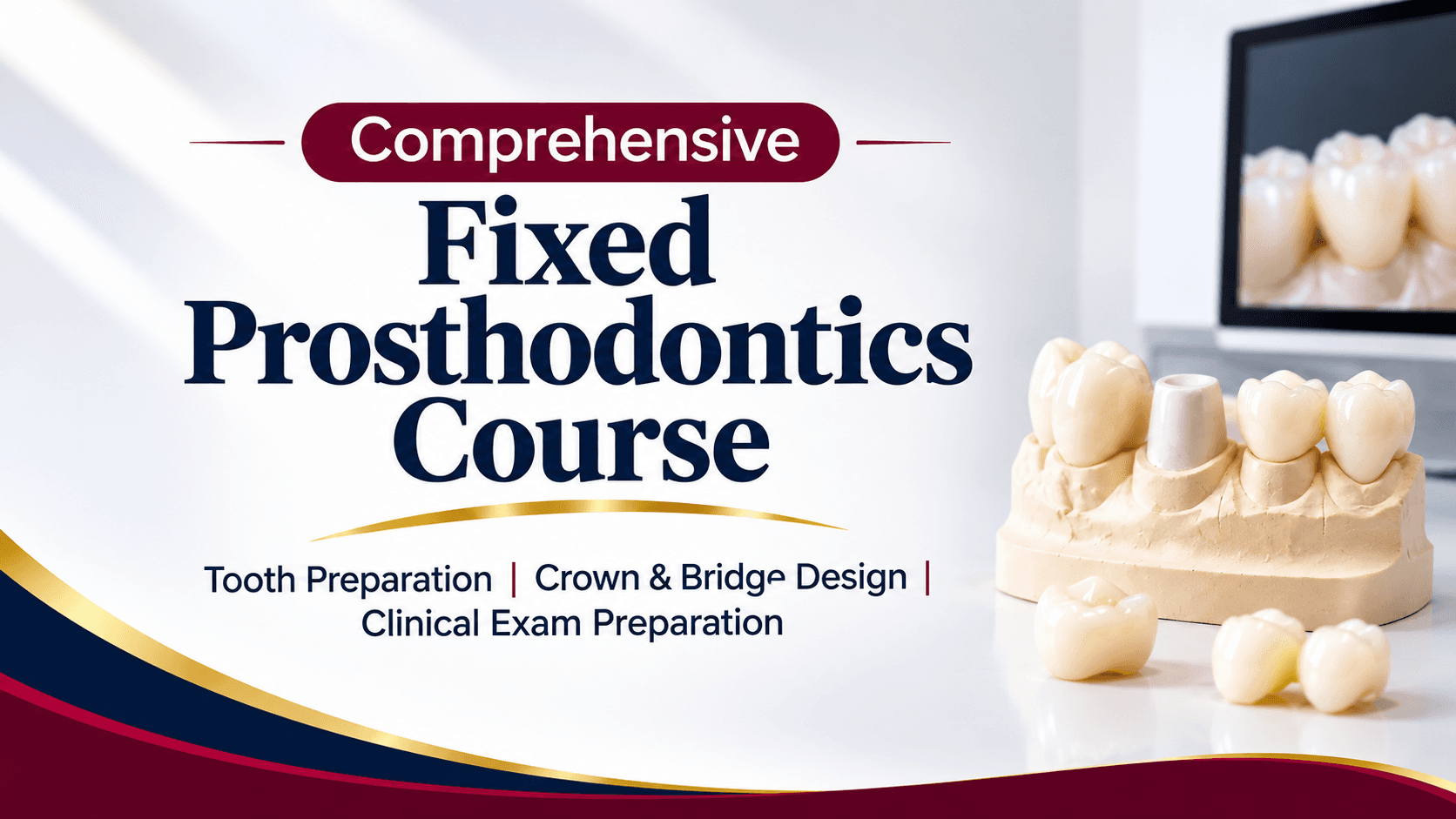
Fixed Prosthodontics Course | Hands-On Crown & Bridge and Tooth Preparation Training
Develop confident crown and bridge skills with MCDI's hands-on Fixed Prosthodontics Course — covering tooth preparation for all ceramic and metal-ceramic restorations, gingival retraction, impression techniques, temporisation, shade selection, and cementation protocols with real patient clinical sessions and expert faculty supervision.
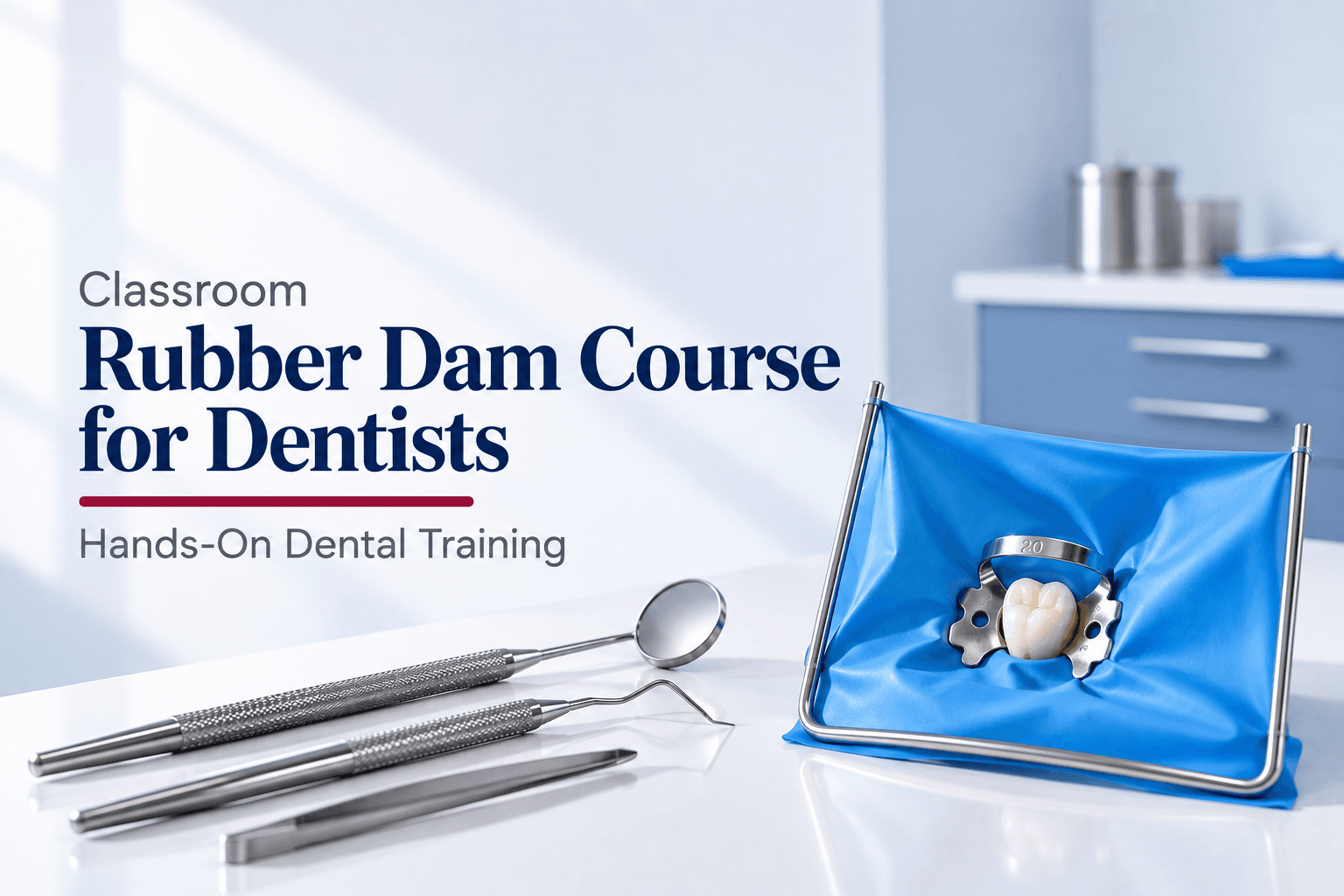
Rubber Dam Course for Dentists | Hands-On Rubber Dam Isolation Training
Hands-on Rubber Dam Course for Dentists. Master isolation, clamp selection & endodontic techniques at MCDI. Offline.
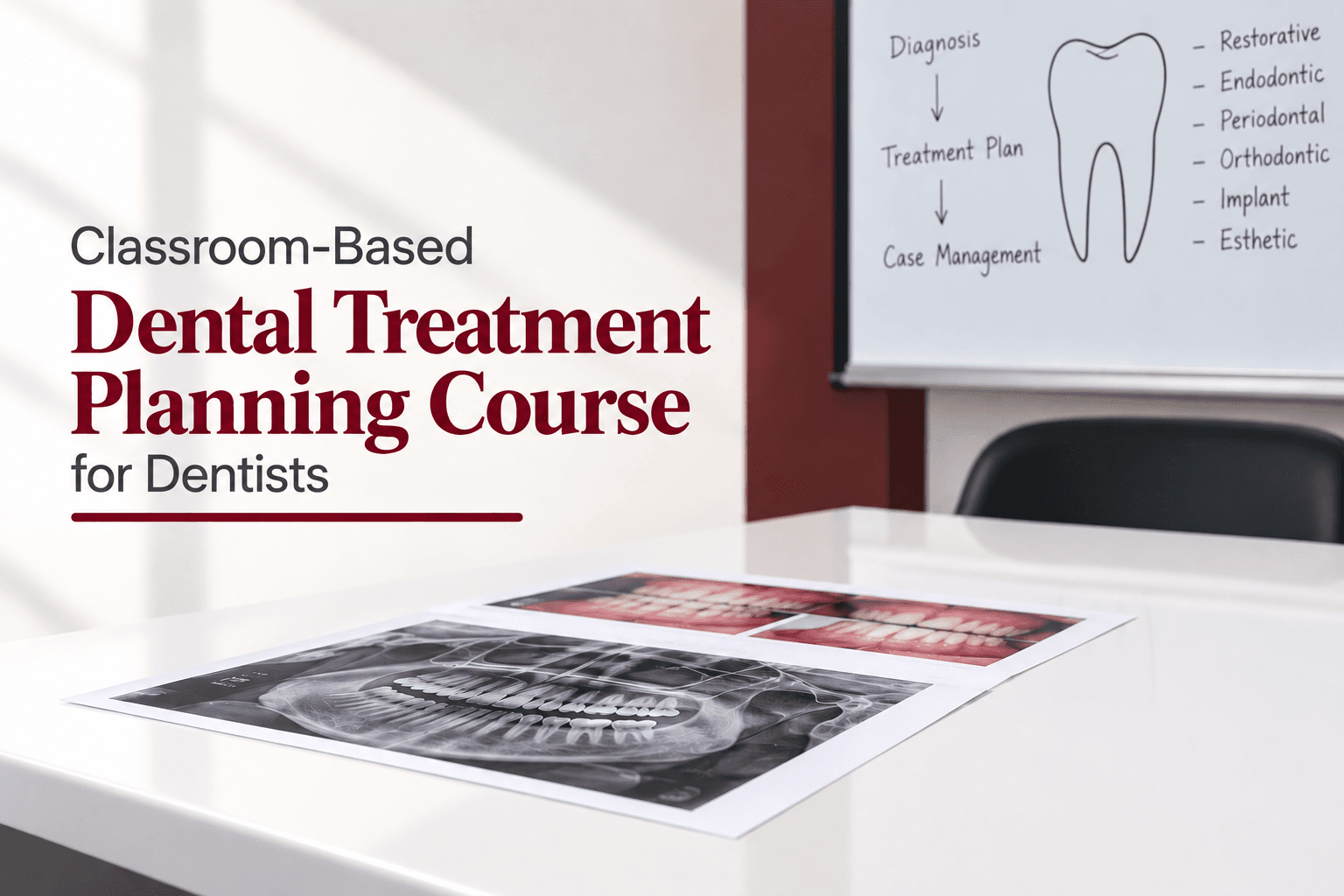
Classroom-Based Dental Treatment Planning Course for Dentists
Build systematic, confident treatment planning skills through case-based workshops, phased design, and real patient assessment sessions.